Young children today are growing up in a world that is radically different from the one in which I was raised. Technology is growing is growing at an ever increasing pace, and things are becoming obsolete before our eyes. I remember that my family got our first television on Thanksgiving day when I was four or five. It was a black and white (as was every other tv) and we watched the Macy's parade. Since I lived in Dutchess County, NY we were able to watch a total of seven channels - ABC, CBS, NBC, PBS, and three independents from the city. (In the hot summer, channels 2 (CBS)and 4 (NBC) ran into each other, so we didn't really have them) Now children have any number of television sets in their house, each with flat screens, living color, VCRs, and 200 channels. Our telephone was a black rotary phone, and we were on a party line with several other houses in the neighborhood. Dinner was always cooked on the stove and typewriters were big clunky machines. When we were teenagers we had the ultimate in new and cool - transistor radios! When I was married, my Aunt Edie from Texas gave me the latest in kitchen tools - an electric frying pan. To top it all off, when I was in college and married, I wrote long letters (by hand!) to my family and friends, walked to the post office to buy the stamps, and waited three or four days for the letter to arrive.
This new world can be confusing (another new version of windows? I just learned how to save a file on the last one!), annoying (Why can't I have caps and punctuation on my text? It is civilized!), and silly (Angry Birds? On a telephone?). Even so, I have found that email is much faster than snail mail if there is something that I want my family to know. I love not having long distance fees when I talk to my daughters for hours. Cable can sometimes be entertaining (as long as no one finds out that I love to watch Lizard Lick Towing). I enjoy keeping up with friends on Facebook, but I am tired of people who post everytime that they brush their teeth. Although I am an avid reader and love the feel of books and the time spent in the library, I am starting to develop Nook lust.
I have two major concerns with the boom in technology. The first is that people are becoming more isolated from others as they stay plugged in to their electronics or sit and play on their computer. There are so many wonderful sounds to hear outdoors, and so many good conversations are missed when ear buds are shoved deep into ears or phone owners are texting rather than listening or conversing. There are so many wonderful things in this world which are being missed in favor of Angry Birds. I realize how adictive these games can be ("I'll just shoot off one more set of balls to see if I can set the monkey free from the poachers and then I will ...."), but it is time to resist the draw of electronic.
My second concern is that electronics are taking the place of people and imagination in young children's lives. Parents are concerned that reading scores among children are dropping in this country, so they buy their children electronic toys or videos to teach the alphabet or nursery rhymes. The only trouble with this is that studies have shown that children do not learn from electronics, but from human interaction. The best thing that a parent can do to help a child prepare to learn to read well uses totally free materials - a library and a lap. Children learn language and reading readiness from people - people who read to them, sing to them, and talk to them about the world around them. This is not the ravings of a cranky grandma; this is factual and backed by sicentific evidence.
When I began in child care (almost thiry years ago - oh, my!), the children played busily during the day. The center was full of the sound of children making noises. They were racing cars, playing puppy, shooting pretend guns (yes, I know that it is not politically correct, but that is a message for another day), cooking food, ringing telephones, roaring dinosaurs, being police sirens ... the list could go on and on. Today, however, every toy makes a sound, if not several sounds so that the children have no need to do so. The solution seems simple - remove the batteries. For every battery that I have removed, a staff member or parent is waiting to replace it so that the "toy will work". (I have discovered that a soak in nice soapy water or a ride through the dishwasher will usually render the electronics inoperable. Since the toys need to be cleaned regularly, this is fairly easy to accomplish!).
Often staff members who are younger do not realize just how much these children have lost by having toys that make all of the noises for them. A few weeks ago one of my younger staff members wanted batteries because one of the fire trucks no longer had a siren. I refused the batteries and told the staff member that the child needed to learn to make the noises himself. I did explain my rationale, and sent them back to play. The staff member tried to encourage the child to be a siren, but he said that he could not. The staff member then asked the child if he knew how a fire truck sounded. The child replies, "Yes. Put in the batteries and you will, too." I rest my case.
Tuesday, October 30, 2012


Friday, September 28, 2012
1200 Words
As I was driving to work yesterday, the disc jockey was talking about a recent scientific study that was done by a psychologist (at least I think he said that it was a psychologist). The study determined that the average person had 1200 words per minute going through his head. I can believe this, since my head is often filled with songs, to-do lists, comments on things that are going on around me, and the Great American Novel that I am sure that I will write some day. (I did spend some time wondering how he actually counted the words per minute - did each subject have to repeat everything that his brain was saying or could they tape them with some kind of CT scan?) This would have just been another interesting bit of trivia if it weren't for one detail that I found very upsetting. It turns out that out of those 1200 words, 1100 of them are negative.
Ninety two per cent of a person's thoughts each minute are negative? I am a generally happy person, and although I occasionally have an unhappy or negative thought I cannot conceive of being so negative most of the time. Is life so difficult? Are so many things going wrong? Is there no hope?
Unfortunately, I think that in many cases negativity is something that has been learned. No one gives lessons in being negative, but it is something that is picked up as we grow. When Rodgers and Hammerstein wrote the score for "South Pacific", they included a song called "They've Got to be Taught." The plot involved a Navy Ensign and a Navy Nurse who were romantically involved with South Pacific natives, but found that they could not act on that attraction because of racial prejudices. They sang about children learning to hate and fear others from their families.
Do we learn negative thoughts from others? I cannot believe that children are born to be negative thinkers. They are busy, inquisitive, emotional, friendly, frightened, hungry, loving, anxious... Children can be many things, and each one has a different personality. There are definately negative moments when a child is afraid, angry, mad, or frustrated, but there are many happy moments also. How does a child learn to be negative? Is it when he hears his adults speaking negatively about others? Is it when he cannot measure up to his adult's expectations? Is it when his adults are ignoring his accomplishments? Is it when his adults are ignoring his questions or treating him like he is stupid? Is it when he is so pampered that he cannot do anything for himself? Is it when he is the target of jokes and comments? I can still remember several times when I was young and an adult made fun of my weight or something that I had done. These adults were relatives and friends of my parents, and I know that they were nice people. Still, my only memories of them are the times that they made fun of me to get a laugh from other adults. What a sad legacy!
The Bible tells us to "raise up a child in the way that he should go and he will follow it all of the days of his life". Children are so precious, and so fragile. Please, please make sure that the children in your life are treated positively so that they may have positive, productive lives. As adults we have so much power to influence the children that we meet - make sure that you are a positive influence.
Ninety two per cent of a person's thoughts each minute are negative? I am a generally happy person, and although I occasionally have an unhappy or negative thought I cannot conceive of being so negative most of the time. Is life so difficult? Are so many things going wrong? Is there no hope?
Unfortunately, I think that in many cases negativity is something that has been learned. No one gives lessons in being negative, but it is something that is picked up as we grow. When Rodgers and Hammerstein wrote the score for "South Pacific", they included a song called "They've Got to be Taught." The plot involved a Navy Ensign and a Navy Nurse who were romantically involved with South Pacific natives, but found that they could not act on that attraction because of racial prejudices. They sang about children learning to hate and fear others from their families.
Do we learn negative thoughts from others? I cannot believe that children are born to be negative thinkers. They are busy, inquisitive, emotional, friendly, frightened, hungry, loving, anxious... Children can be many things, and each one has a different personality. There are definately negative moments when a child is afraid, angry, mad, or frustrated, but there are many happy moments also. How does a child learn to be negative? Is it when he hears his adults speaking negatively about others? Is it when he cannot measure up to his adult's expectations? Is it when his adults are ignoring his accomplishments? Is it when his adults are ignoring his questions or treating him like he is stupid? Is it when he is so pampered that he cannot do anything for himself? Is it when he is the target of jokes and comments? I can still remember several times when I was young and an adult made fun of my weight or something that I had done. These adults were relatives and friends of my parents, and I know that they were nice people. Still, my only memories of them are the times that they made fun of me to get a laugh from other adults. What a sad legacy!
The Bible tells us to "raise up a child in the way that he should go and he will follow it all of the days of his life". Children are so precious, and so fragile. Please, please make sure that the children in your life are treated positively so that they may have positive, productive lives. As adults we have so much power to influence the children that we meet - make sure that you are a positive influence.
Sunday, July 22, 2012
I'm In the City Now!
I am quickly approaching the fifth anniversary of employment at the center. I have been very happy here, and enjoy the staff, the church members (we are located in a Lutheran church), and - most of all - the children in our care. There have been some adjustments, however, now that I am working in the city. (Note: People who live here will tell you that this is not the city, that it is a suburb. It does, however, have the name of the city as its address. In addition, it has sidewalks, street lights, stop lights, lots of buildings, and big, smelly buses. That is a city.) I have never spent much time in a city, so my tenure here has been very instructive and I have learned a lot about life in the city. The things that I have learned include:
1. Dog owners in the city tend to carry baggies to deal with anything that their dog may produce during the walk. This is a nice change from the country, where dog owners tend to just let their dog out the door. I spend a good amount of time pooper-scooping my lawn, which wouldn't bother me so much if I actually owned a dog.
2. The city has squirrels. I know that they are a nuisance, and that people tend to dislike them, but I love to watch them run and play. We have recently acquired a squirrel or two in Retsof but one at a time is not as entertaining as several. We used to have lots of little red squirrels at our house, but that was because Alexander (one of our cats) brought them home from the woods across the street, and since Alexander is no longer with us the red squirrels are gone.
3. I don't think that there are amusement parks in the city because every time that I get on the expressway someone is trying to ram my car. Perhaps if they could play bumper cars they would leave mine alone.
4. It take forever to get anyplace in the city. Going five miles down the road can take fifteen minutes or more because of stop lights, bus stops, and kamikaze pedestrians. At home we are only held up if Cuozzo's cows are in the road again.
5. There are dozens of pizza parlors, fast food places, sub shops, and restaurants. Does anyone in the city cook?
6. This one is really scary - "People of Walmart" really do exist. Most of them are very friendly and love to chat, but I am not sure that I want to stand too close to them.
7. People get cranky when my attention wanders at long stop lights and I forget to watch for the green. There are really more interesting things to look at than stop lights.
8. I have learned that when the speed limit drops to 55 on the expressway, it is not a good idea to slow down to 55 if you value the rear end of your car.
9. There are elevators everywhere. I think that there are only two or three in my county.
10. Often when I am leaving a store, the cashier or door guard will tell me to "Be blessed" or to "Have a blessed day". What a happy thought!
1. Dog owners in the city tend to carry baggies to deal with anything that their dog may produce during the walk. This is a nice change from the country, where dog owners tend to just let their dog out the door. I spend a good amount of time pooper-scooping my lawn, which wouldn't bother me so much if I actually owned a dog.
2. The city has squirrels. I know that they are a nuisance, and that people tend to dislike them, but I love to watch them run and play. We have recently acquired a squirrel or two in Retsof but one at a time is not as entertaining as several. We used to have lots of little red squirrels at our house, but that was because Alexander (one of our cats) brought them home from the woods across the street, and since Alexander is no longer with us the red squirrels are gone.
3. I don't think that there are amusement parks in the city because every time that I get on the expressway someone is trying to ram my car. Perhaps if they could play bumper cars they would leave mine alone.
4. It take forever to get anyplace in the city. Going five miles down the road can take fifteen minutes or more because of stop lights, bus stops, and kamikaze pedestrians. At home we are only held up if Cuozzo's cows are in the road again.
5. There are dozens of pizza parlors, fast food places, sub shops, and restaurants. Does anyone in the city cook?
6. This one is really scary - "People of Walmart" really do exist. Most of them are very friendly and love to chat, but I am not sure that I want to stand too close to them.
7. People get cranky when my attention wanders at long stop lights and I forget to watch for the green. There are really more interesting things to look at than stop lights.
8. I have learned that when the speed limit drops to 55 on the expressway, it is not a good idea to slow down to 55 if you value the rear end of your car.
9. There are elevators everywhere. I think that there are only two or three in my county.
10. Often when I am leaving a store, the cashier or door guard will tell me to "Be blessed" or to "Have a blessed day". What a happy thought!
Friday, June 22, 2012
Training a Director Really Needs
Today I was visiting an early childhood training organization's website to discover what workshops were available in the Rochester area and to register for any new ones. As a director I am always looking for excellent training that would improve my teaching and my administrative skills. Like many directors, I was multitasking; in this case I was mending a red teddy bear while I was reading. The bear, which is the much loved possession of one of the three year old boys, often comes into the office to have his seams closed or his limbs reattached.
The workshop list contained trainings on many of the skills that child care directors need: staff orientation, marketing, supervisory skills, fiscal skills, and child assessment. The combination of trainings and red bear made me think about other imprtant trainings that child care directors could use. The training catalog should include:
1. Basic sewing - This course would give the director expertise in mending stuffed animals, dolls, and blankets. A segment will cover clothing, since once staff members discover that the director can sew, they will bring in garments that need to be hemmed or to have buttons reattached. (I have even had children bring me their clothes that needed to be mended.)
2. Plumbing for Dummies - Learn how to replace a faucet, repair a leaking pipe, replace a trap which has developed a hole, and how to unclog a toilet that is full of tp, Legos, shoes, etc. Plungers, snakes, and wrenches will be provided, but they will not necessarily be the correct size/strength.
3. Beginning Carpentry - This course would give you the skills to replace hooks in cubbies, replace the backs on mailbox units, and wood glue the arms back on the rocking chair. Included at no extra charge is information on assembling wood kitchen sets that come with one part missing and directions that were written by someone who has never seen the kitchen set plans or parts.
4. Midwifery - Provides the necessary skills to deal with birthing mothers, including hamsters, gerbils, guinea pigs, and (in one memorable incident) staff members. This course may be taken in combination with:
5. Ceremonies - This course will help the director to recognize and handle all of the details that need to be considered when planning a pet's funeral. Topics covered include picking out the correct size shoe box, stealing a receiving blanket from the baby room without being caught, the funeral procession to the playground (single file vs. double file), and musical arrangements (how many songs should the children pick out?). As a special bonus, there will be information on funerals that involve flushing fish.
6. Treasure Hunting - Learn valuable information about removing stones, beads, Legos, etc. from noses and ears.
7. Physics - Discover how to remove blocks, balls, and matchbox cars from objects that they could not possibly fit into.
More courses will be available on request.
The workshop list contained trainings on many of the skills that child care directors need: staff orientation, marketing, supervisory skills, fiscal skills, and child assessment. The combination of trainings and red bear made me think about other imprtant trainings that child care directors could use. The training catalog should include:
1. Basic sewing - This course would give the director expertise in mending stuffed animals, dolls, and blankets. A segment will cover clothing, since once staff members discover that the director can sew, they will bring in garments that need to be hemmed or to have buttons reattached. (I have even had children bring me their clothes that needed to be mended.)
2. Plumbing for Dummies - Learn how to replace a faucet, repair a leaking pipe, replace a trap which has developed a hole, and how to unclog a toilet that is full of tp, Legos, shoes, etc. Plungers, snakes, and wrenches will be provided, but they will not necessarily be the correct size/strength.
3. Beginning Carpentry - This course would give you the skills to replace hooks in cubbies, replace the backs on mailbox units, and wood glue the arms back on the rocking chair. Included at no extra charge is information on assembling wood kitchen sets that come with one part missing and directions that were written by someone who has never seen the kitchen set plans or parts.
4. Midwifery - Provides the necessary skills to deal with birthing mothers, including hamsters, gerbils, guinea pigs, and (in one memorable incident) staff members. This course may be taken in combination with:
5. Ceremonies - This course will help the director to recognize and handle all of the details that need to be considered when planning a pet's funeral. Topics covered include picking out the correct size shoe box, stealing a receiving blanket from the baby room without being caught, the funeral procession to the playground (single file vs. double file), and musical arrangements (how many songs should the children pick out?). As a special bonus, there will be information on funerals that involve flushing fish.
6. Treasure Hunting - Learn valuable information about removing stones, beads, Legos, etc. from noses and ears.
7. Physics - Discover how to remove blocks, balls, and matchbox cars from objects that they could not possibly fit into.
More courses will be available on request.
Monday, June 11, 2012
Let's All Honk!
As a child care director, I attend leadership conferences. This gives me a chance to network with other directors and exchange ideas as well as helping me to improve my directing skills. (Like many directors, I became a director with two weeks notice and little administrative experience, so I learned by fumbling along) A popular theme in administrative meetings right now is imitating geese and flying in a V. The discussions cover how geese help each other, share the burden, and stay with the geese who are having trouble. These are great ideas, but I think that we could improve by following other aspects of geese.

I know that many think of geese are a nuisance, but I love them. I love watching the large V as they fly overhead on their way south or north. My heart lifts when I hear them honking because I know that they are signaling a change in the seasons. I love seeing them in the cornfields as they break their journey and look for corn that was missed in the harvest. I love the special times that I spy snow geese near the Canadian geese. My favorite time, however, is when the goslings hatch and start to venture out with their parents.

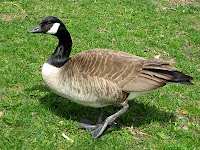
Recently, I was driving through a business park while taking a short cut on my way to pick up the center's weekly order at Sam's Club. As I rounded a curve, I noticed that traffic was stopped in both lanes. Was it an accident? A breakdown? A traffic stop? No - it was a Canadian goose strutting across the road followed by eight fuzzy yellow goslings. They were stepping across the street in a perfect line while about a dozen cars sat and waited for them to pass. Even better, another goose was at the end of the line, marching sedately behind all of the others. As the last gosling cleared the curb, he stopped in the middle of the lane, raised his head, and honked at all of the cars. I chuckled about him all day long.

Why should we copy the geese? They knew where their children were at all times, and kept them protected between the two adults. I am not talking about turning everyone into the helicopter parents who never give their children freedom to grow or to make mistakes, but about those parents (and, unfortunately, caregivers) who never seem to know where their children are much of the time. I cannot be the only one who has watched a little one wander around the mall while their parent is on their cell phone. How does a parent leave a child in a Burger King when the family leaves? How can a child care provider leave a child on the playground when everyone goes inside? How can a bus driver leave a child on the bus for six hours while the bus sits in the garage? The geese seem to do it better than many humans manage to do.
Several days ago I was in Wegmans doing the week's grocery stopping. A young child (4 or 5) was upset because his little brother had his toy and would not give it back. The mother kept telling him to be quiet because his brother was using the toy. The boy, who was becoming quite upset, went into the produce preperation area, which was empty for the evening. The mother, whose child was now out of sight in an area that was filled with big knives for cutting up fruit and who knows what else, reacted by saying, "Good-bye, Bobby" and pushing the cart out of the produce area and into the grocery area. Fortunately, the older brother, who was about seven, came back, brought the boy out of the preparation area, and followed the mother. This is one child who would have benefited from being raised by a goose.

I know that many think of geese are a nuisance, but I love them. I love watching the large V as they fly overhead on their way south or north. My heart lifts when I hear them honking because I know that they are signaling a change in the seasons. I love seeing them in the cornfields as they break their journey and look for corn that was missed in the harvest. I love the special times that I spy snow geese near the Canadian geese. My favorite time, however, is when the goslings hatch and start to venture out with their parents.
Recently, I was driving through a business park while taking a short cut on my way to pick up the center's weekly order at Sam's Club. As I rounded a curve, I noticed that traffic was stopped in both lanes. Was it an accident? A breakdown? A traffic stop? No - it was a Canadian goose strutting across the road followed by eight fuzzy yellow goslings. They were stepping across the street in a perfect line while about a dozen cars sat and waited for them to pass. Even better, another goose was at the end of the line, marching sedately behind all of the others. As the last gosling cleared the curb, he stopped in the middle of the lane, raised his head, and honked at all of the cars. I chuckled about him all day long.
Why should we copy the geese? They knew where their children were at all times, and kept them protected between the two adults. I am not talking about turning everyone into the helicopter parents who never give their children freedom to grow or to make mistakes, but about those parents (and, unfortunately, caregivers) who never seem to know where their children are much of the time. I cannot be the only one who has watched a little one wander around the mall while their parent is on their cell phone. How does a parent leave a child in a Burger King when the family leaves? How can a child care provider leave a child on the playground when everyone goes inside? How can a bus driver leave a child on the bus for six hours while the bus sits in the garage? The geese seem to do it better than many humans manage to do.

Several days ago I was in Wegmans doing the week's grocery stopping. A young child (4 or 5) was upset because his little brother had his toy and would not give it back. The mother kept telling him to be quiet because his brother was using the toy. The boy, who was becoming quite upset, went into the produce preperation area, which was empty for the evening. The mother, whose child was now out of sight in an area that was filled with big knives for cutting up fruit and who knows what else, reacted by saying, "Good-bye, Bobby" and pushing the cart out of the produce area and into the grocery area. Fortunately, the older brother, who was about seven, came back, brought the boy out of the preparation area, and followed the mother. This is one child who would have benefited from being raised by a goose.

Friday, May 4, 2012
Thoughts
My sister emailed me a few days ago about her three year old grandchild, who she feels is very cute and very bright (while he is, I don't have the heart to tell her that my grandchildren are obviously much cuter and brighter!). While he was visiting he asked to see the creek behind the house. My sister felt that it would not be very interesting because the water level was low, but they walked down to the creek. The grandson looked at the creek and told her, "It's full of allergies". "Allergies"? In a creek? Suddenly it dawned on her - there was algae in the creek. The grandson was commenting on the fact that he saw algae in the creek.
 Now, this is a very cute story, and I enjoyed it very much. While I enjoyed it because it was funny and made me laugh, I enjoyed it even more because of what it told me about the grandson's life. This is a child who is obviously interested in what is going on around him and who enjoys being outside. This means that he has parents and grandparents who let him run around, investigate, and enjoy nature. He observes his surroundings and talks about what he sees, which means that adults are looking and talking with him. He is comfortable in the outdoors, which means that he has spent time in the fresh air. He has an unusual vocabulary, which means that he has been developing communication and language skills by talking with the adults in his life. Children do not learn about algae by playing Angry Birds or by watching cartoons. This is a child who has an excellent start in life because the adults in his life are paying attention to him rather than parking him in front of "educational" electronics.

Several days later my sister sent a picture that grandson had painted for her. He told her that it was a picture of a circle, and she had framed it and hung it in her living room. I always admire people who frame and display children's art (don't tell my sister, however) because I tend to be the sort of refrigerator magnet decorator. I enjoy his paintings and his sense of color, but I especially enjoy them because his parents and grandparents enjoy, admire, and treasure them. What seem to adults to be mindless scribbling and swiping are actually very important developmental steps for a child. A child needs to go through 80 stages of scribbling before they can begin to form letters. These first attempts at writing and drawing are the equivalent of learning to crawl, stand, and walk, but many parents treat small children's art as if it were meaningless, rather than celebrating it with their child. One of the saddest sight that I see in a child care classroom is a cubby stuffed full of a child's art that has been accumulating for several months. Even sadder are the parents who tell the staff to "just throw it out". (My staff, by the way, will not throw out a child's art.) A child who is prewriting, drawing, coloring, writing, cutting, and pasting is learning many important skills which include: fine motor control, sorting and classifying (math skills), color mixing (science), and self-expression, not to mention the language, communication, and social skills that are developed when the child talks to an adult about their artwork. Parents who are pushing their children to learn what they believe is necessary to become ready for kindergarten give the children no encouragement when they take the steps that are needed to develop the skills. Children are excited and proud about their work, and having a loved one ignore it to throw it into the garbage without looking at it is horribly unkind. A picture in a frame seems to be a small thing, but it speaks volumes about the way that his family understands the grandchild and how much they value him.
So what is my point in all of this? Rather than worrying that your child is not learning enough to be ready for school, get involved with him. Put down your ipad, turn off the tv (and don't tell me that it is educational videos - that is usually an oxymoron!), turn off your phone, and spend time with your child. Talk about what you see, what you are doing, and what is happening. Use grownup words and talk as if you were talking to a peer - that is how children learn language. If you always baby talk or use one syllable words, so will your child. Not only will you be helping your child to succeed, you will be having a whole lot of fun!


Several days later my sister sent a picture that grandson had painted for her. He told her that it was a picture of a circle, and she had framed it and hung it in her living room. I always admire people who frame and display children's art (don't tell my sister, however) because I tend to be the sort of refrigerator magnet decorator. I enjoy his paintings and his sense of color, but I especially enjoy them because his parents and grandparents enjoy, admire, and treasure them. What seem to adults to be mindless scribbling and swiping are actually very important developmental steps for a child. A child needs to go through 80 stages of scribbling before they can begin to form letters. These first attempts at writing and drawing are the equivalent of learning to crawl, stand, and walk, but many parents treat small children's art as if it were meaningless, rather than celebrating it with their child. One of the saddest sight that I see in a child care classroom is a cubby stuffed full of a child's art that has been accumulating for several months. Even sadder are the parents who tell the staff to "just throw it out". (My staff, by the way, will not throw out a child's art.) A child who is prewriting, drawing, coloring, writing, cutting, and pasting is learning many important skills which include: fine motor control, sorting and classifying (math skills), color mixing (science), and self-expression, not to mention the language, communication, and social skills that are developed when the child talks to an adult about their artwork. Parents who are pushing their children to learn what they believe is necessary to become ready for kindergarten give the children no encouragement when they take the steps that are needed to develop the skills. Children are excited and proud about their work, and having a loved one ignore it to throw it into the garbage without looking at it is horribly unkind. A picture in a frame seems to be a small thing, but it speaks volumes about the way that his family understands the grandchild and how much they value him.
So what is my point in all of this? Rather than worrying that your child is not learning enough to be ready for school, get involved with him. Put down your ipad, turn off the tv (and don't tell me that it is educational videos - that is usually an oxymoron!), turn off your phone, and spend time with your child. Talk about what you see, what you are doing, and what is happening. Use grownup words and talk as if you were talking to a peer - that is how children learn language. If you always baby talk or use one syllable words, so will your child. Not only will you be helping your child to succeed, you will be having a whole lot of fun!
Sunday, April 22, 2012
Yogurt
As I have explained before, my greatest interests are young children, nutrition, and cooking. Fortunately for me, these interests combine easily and work together well. This does not always happen - imagine trying to cook while skydiving... Anyway, I have begun making my own yogurt. It is easy, cheap (a week's worth of yogurt for about 99 cents), and it really impresses people who don't know how easy it really is. Yogurt making is very simple, and children can help.
All you need for successful yogurt making is a kettle, thermometer, whisk, 8 cups of milk (any kind - I use skim), and a small container of plain yogurt. You do not need olive oil - that was just on the counter.


Take the pot of milk off the burner and let it cool to between 120 and 110 degrees. Put about 1/2 cup (more or less) plain yogurt into a bowl. Add about a cup of the warm milk, whisk until smooth, and add to the pot of warm milk. Stir. Do not try to save time by stirring the yogurt directly into the milk - you will have lumps of yogurt (trust me on this, too!),

Place the mixture into a container with a lid. The mixture will have to stay warm to incubate for at least eight hours. I found that the best way for me was to wrap it in an old bath towel and place in one of those foil-lined insulated Wegmans bags with a zip lid. Any kind of container that would hold the temperature would work.


The yogurt can be removed after eight hours, or it can stay longer. I often make mine after work and leave it overnight, and I have left it as long as 24 hours. The longer the yogurt incubates, the thicker it becomes and the more the flavor develops. To thicken it a little more, I strain it through a colander that is placed over a bowl. I line it with an old cotton dish towel, and I strain a few cups at a time just to make it easier to scoop into the containers that I use to store it (in my case, I have a complete matching set of margarine containers).


All you need for successful yogurt making is a kettle, thermometer, whisk, 8 cups of milk (any kind - I use skim), and a small container of plain yogurt. You do not need olive oil - that was just on the counter.

Heat the milk to 180 degrees to separate the proteins. If your thermometer is the kind that is encased in Pyrex, make sure that it is not touching the bottom of the pan, since it will not read correctly. Stir the milk occasionally to prevent sticking. If you are the type that multitasks, do not wander off. scorched yogurt tastes terrible, and if it boils onto the stove it makes a mess (trust me on this one!).

Take the pot of milk off the burner and let it cool to between 120 and 110 degrees. Put about 1/2 cup (more or less) plain yogurt into a bowl. Add about a cup of the warm milk, whisk until smooth, and add to the pot of warm milk. Stir. Do not try to save time by stirring the yogurt directly into the milk - you will have lumps of yogurt (trust me on this, too!),

Place the mixture into a container with a lid. The mixture will have to stay warm to incubate for at least eight hours. I found that the best way for me was to wrap it in an old bath towel and place in one of those foil-lined insulated Wegmans bags with a zip lid. Any kind of container that would hold the temperature would work.


The yogurt can be removed after eight hours, or it can stay longer. I often make mine after work and leave it overnight, and I have left it as long as 24 hours. The longer the yogurt incubates, the thicker it becomes and the more the flavor develops. To thicken it a little more, I strain it through a colander that is placed over a bowl. I line it with an old cotton dish towel, and I strain a few cups at a time just to make it easier to scoop into the containers that I use to store it (in my case, I have a complete matching set of margarine containers).

Draining the yogurt takes off some of the whey and thickens the yogurt. Exactly how much you drain off will depend on the thickness of the yogurt when you start and on your patience while you are draining it. It is okay to wander away during the draining; in fact, I recommend it. Make sure to save the whey in the refrigerator - it is wonderful for baking. You do not need to use anything fancy to store the whey, although I do have a lovely matched set of mayonnaise jars.

Your yogurt will be thick, much like Greek yogurt, and will be tart because it is plain yogurt. It can be sweetened with sugar or honey. I usually eat mine plain, since I put it over fruit which sweetens it enough. This is a matter of taste. Once you have made a batch, there is not need to purchase more yogurt, since you can use the batch that you made to start a new batch.
Yogurt is very easy to make, especially once you have made it several times. It is a great feeling to produce something that is so good and healthy while saving money also. Have fun and enjoy!
Subscribe to:
Posts (Atom)